New Orleans House Project

Showing posts with label vintage sewing machines. Show all posts

Sunday, March 18, 2018

Machine Appliqué with a Vintage Twist

I guess 2018 is turning out to be my Year of Machine Appliqué!

I finished the first block - Sweet Cherry - in the Gathered Harvest BOM sponsored by my LQS, Quilted Owl.  The patterns are from Fresh Picked by Blackbird Designs.  

I prepped all the appliqué pieces using freezer paper and starch.  Next I laid the pieces out on the background fabric, so I could figure out the order to stitch each piece.  I worked in sections, using fabric glue to adhere the pieces to the background for sewing.  Using invisible nylon thread on top and Aurifil 50 weight thread in the bobbin, I stitched each piece with a very narrow zigzag stitch.  

I have started the prep work for block number 2 - Fresh Pineapple.  I'm only two months behind on the BOM process, but I'd be even farther behind if I were stitching each block by hand!

Since I've been experimenting with different machine appliqué techniques this year, I decided it was time to experiment with a different sewing machine as well.  I've had this vintage Singer sewing machine for years, but it was neglected in favor of other vintage machines.  Unlike all the other vintage sewing machines in my flock, this machine can do zigzag stitching (and more).

The machine is a Singer 503A - which was a new design, introduced in 1961.  The 503A and its cousin the 500A, are also known as the Rocketeer - at least among sewing machine enthusiasts.  It's definitely got that mid-century space age vibe going!  The two Rocketeer machines were the last of the all-metal gear Singer machines.

The 503A sews several different stitches in addition to straight stitch and zigzag.  By changing the cams included with the machine, sewists can create a variety of decorative stitches.  The cams (Singer called them Fashion Discs) drop into the round opening to the right of the thread holders.  

The needle placement can be changed using the triangular knob.  The stitch width adjustment, to the left of the needle placement knob, allows for different widths on the zigzag and other decorative stitches.  The stitch length lever allows for forward and reverse stitching.  There's also a light under the Singer logo.

Probably the best reason to use this machine for appliqué is the slant needle feature.  Singer slant needle machines have a needle bar that is slanted forward, which allows for much easier visualization of the stitching area.  The only thing that would make the appliqué stitching a little easier here would be an open-toe presser foot - which can be purchased online for a few dollars.

So - how did the Rocketeer handle appliqué with invisible thread?  Like a champ!  I used Aurifil 50 weight thread in the bobbin and a polyester invisible thread on top.  I needed to loosen the upper thread tension a good bit, but the machine handled the poly thread just fine.  Going forward, I'll use a finer gauge needle (the machine uses standard 15x1 sewing machine needles) and I'm going to order an open toe foot attachment.  I'm going to keep the Rocketeer at our camp, so I can still do machine appliqué when we're there for the weekend.

I stitched up two more appliqué baskets yesterday to work out the process.  

This may become a project after all!


Sunday, February 4, 2018

Finished Flimsy: Treadle On Origami Bow-Tie Blocks

I finished machine-stitching the appliqué border on my Origami Bow-Tie blocks this week.  Once I started the machine stitching, I kind of got into a rhythm and just kept working at it until it was finished.  I don't have any solid plans for the quilting yet; I'm just happy to have the finished flimsy!

I used Soft Fuse to hold the appliqué shapes in place (fabric glue for the vines), then machine-stitched a blanket stitch edging on all the shapes.  The border design is from Fons and Porter's Quick Quilts from the Heart.  The stitching was not difficult, but I did find I needed to be careful to use good posture, remember to breathe (!) and take frequent breaks to stretch and rest my wrists and hands.

The Origami or 3-D Bow-Tie blocks were from an exchange among antique and vintage sewing machine users from the Treadle On mail list.  The exchange requirements included using reproduction quilting fabric and stitching the blocks on a pre-1900 people-powered sewing machine.  

These blocks will always have a special place in my heart because I received them during my exile from New Orleans after Hurricane Katrina.  My son and I were living with my sister's family in Florida so my son could continue to attend high school - his school had taken on over 12 feet of water and was in no shape for classes.  My husband had gone back to New Orleans to work, because his hospital was one of the only functioning hospitals in the metro area.  I looked for a job in Florida, but although folks were sympathetic, they weren't interested in hiring a temporary employee.  I didn't have any access to Fabric Therapy, so I spent my days reading and trying not to watch television coverage about the flooding in New Orleans.  When my package of blocks arrived in the mail, it was a harbinger that life might eventually return to "normal".  Not long after that, we learned electricity had been restored to our neighborhood, my son's school had arranged for classes to be held at an alternate location and we would be able to go home!


Friday, December 30, 2016

Last Vintage Montage of 2016

I find most types of traditional shopping tedious:  groceries, clothes, shoes, home decor - all boring!
 On the other hand, antique malls, flea markets, thrift stores, estate sales...and fabric stores - I'm in shopping heaven!  Dear Husband and I enjoy the hunt for treasures in all these places (he's not crazy about fabric stores - probably just as well!) and have had some good finds lately.
 
This log cabin cream and sugar set in cobalt blue glass caught our eye in an antique mall near my mom's house in Florida. 

More cobalt blue glass - a calf on a lidded dish.

Vintage sewing items always catch my eye.  The needle packages are from an estate sale.  The Clover sewing tin was an unexpected surprise.  Clover makes all kinds of sewing, knitting and crochet notions, but their modernist take on design made me think the company was a twenty-first century production.

Apparently not - as the interior of the sewing kit is definitely mid-century modern!  That sassy, sewing cat is a hoot!

Also tucked into the sewing kit was this store guide to a Japanese department store.  It's a little surprising the guide is in English - were Westerners common visitors to Japan in the 1950s?  Was the kit purchased by an American visiting Japan at that time?   

Lots of vintage linens have come home with me in the past few weeks.  These Scotties are my favorite!

I found this fabulous sewing machine cabinet and chair at an estate sale in my own back yard!

The sewing machine is one I've had for a number of years.  It's a Model 201k from the 1950s.  Unlike the traditional black cast iron models, this one is made of aluminum, so it's not quite as heavy.  It still sews like a dream and can sew through just about anything.  I look forward to using this machine on a regular basis now that it has a permanent cabinet!   


Sunday, February 19, 2012

Pieces of the Past: Presidents, Patriotism and Sewing Machines

In honor of Presidents Day, I offer some sewing machine vignettes from the history of the United States.

Victorian trade card for Household Sewing Machine Co. featuring images of President & Mrs. Grover Cleveland, circa 1886.

President Cleveland married Frances Folsom in 1886 - the first wedding to ever be held in the White House.  She was 21 and the daughter of one of Cleveland's former business partners; he was 48 years old at the time and had never been married (although he admitted to fathering an out-of-wedlock child when the issue was dragged up by his opponents during the 1884 Presidential election).  Mrs. Cleveland proved to be a very popular First Lady and advertisers were quick to use her image to promote products - apparently without her permission.  So although this appears to be an endorsement of Household sewing machines, I doubt Mrs. Cleveland (or her staff) ever actually used one.

Victorian trade card for Weed Sewing Machine Co. featuring Uncle Sam.

Uncle Sam is demonstrating the Weed sewing machine (the company name and info is given on the reverse of the card) for a group of stereotypical foreign onlookers.  Weed sewing machines were manufactured in Hartford, CT from 1865-1900.  No date or specific reference to a particular "world's fair" is given.  We can speculate that perhaps the card refers to the World's Columbian Exposition, held in Chicago in 1893.  The image of Uncle Sam as a personification of the United States was frequently seen on Victorian trade cards.

Paper doll featuring a young girl sewing a US flag with a Wheeler & Wilson sewing machine.

This image is a die-cut design and has a stand-up support printed with an 1899 calendar.  I'm not sure of the significance of the word "Olympia" on the young lady's hat.  I always assumed she was meant to be a younger version of Columbia, a female personification of the United States.  Like Uncle Sam, Columbia was a popular image found in late 19th century advertising.

Patriotic postcard depicting sewing machine

Dating from the WW I era, this postcard promotes home sewing as a patriotic activity.  "What Can We Do For Home and Country?  We can economize by making our own clothes"

There you have it - Presidents Day is a perfect holiday to celebrate your sewing heritage!


Saturday, January 28, 2012

Treadling Toward Retirement?

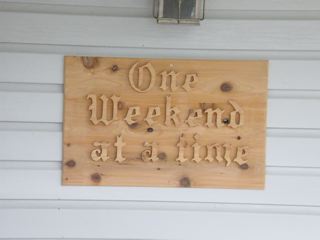
Several years ago my DH decided we could never afford to retire, so he wished to begin enjoying his retirement now, "one weekend at a time".  We searched for almost two years to find just the right place to escape the stresses of work and urban life, preferably on or very near the water.  We finally found just the right place and have been enjoying One Weekend At A Time whenever the opportunity presents itself.
My Dear Husband created this sign to announce his retirement policy.
Although I enjoy all the outdoor activities our weekend home has to offer, I can't escape from the stresses of work without some quilting, too!  To that end, I duly installed one of my favorite sewing machines at the camp:
This beauty is a Singer Model 15 treadle.  Collectors call the decals on this machine "Sphinx" or "Memphis".  I can't say exactly how old this machine is, but I don't think she was heavily used, as her decals are in beautiful condition.  Yes, I know it is possible to assign a date to Singer machines based on their serial number.  However, those numbers are only a guide to the general timeframe a machine was manufactured, and should only be used as a guide.  Besides, the machine is at the camp and I'm at home - I don't have the serial number written down anywhere.

The Singer Model 15 is a terrific workhorse sewing machine.  It sews a fantastic straight stitch and has a huge bobbin capacity.  These old machines were made to last and since they don't have plastic parts and electronics, they are simple to maintain.  My particular model only has a knob for stitch length adjustment, but later models have a stitch length adjustment lever and can also sew in reverse.  
The most distinctive characteristic of the Model 15 is the placement of the tension adjustment knob on the back of the machine.  If you find a machine with this type of tension adjustment, chances are it is a Model 15 or a Japanese copy of a Model 15.  Between Singer's manufacture and all the Japanese clones that appeared after WWII, the Model 15 was in production for a long time.  If you are looking for a reliable straight-stitch machine without investing an arm and a leg, you won't go wrong with a Model 15 or a clone.
Using a treadle sewing machine is pretty simple.  It might take a little practice to get the hang of it, but the treadle motion quickly becomes second nature.  The added exercise is a nice plus, too.  Living on the Gulf Coast - where power failures can happen with even a mild thunderstorm - it's also very convenient to have an electricity-free sewing machine! 

The Age of the Interwebs has made it easy to find antique and vintage sewing machine resources.  If you are interested in using a people-powered sewing machine, I recommend the Treadle On website as a great starting point.  It's a down-to-earth website loaded with practical information presented in a straightforward, but fond and often humorous way.  Treadle On!