New Orleans House Project

Showing posts with label antique sewing machines. Show all posts

Sunday, February 4, 2018

Finished Flimsy: Treadle On Origami Bow-Tie Blocks

I finished machine-stitching the appliqué border on my Origami Bow-Tie blocks this week.  Once I started the machine stitching, I kind of got into a rhythm and just kept working at it until it was finished.  I don't have any solid plans for the quilting yet; I'm just happy to have the finished flimsy!

I used Soft Fuse to hold the appliqué shapes in place (fabric glue for the vines), then machine-stitched a blanket stitch edging on all the shapes.  The border design is from Fons and Porter's Quick Quilts from the Heart.  The stitching was not difficult, but I did find I needed to be careful to use good posture, remember to breathe (!) and take frequent breaks to stretch and rest my wrists and hands.

The Origami or 3-D Bow-Tie blocks were from an exchange among antique and vintage sewing machine users from the Treadle On mail list.  The exchange requirements included using reproduction quilting fabric and stitching the blocks on a pre-1900 people-powered sewing machine.  

These blocks will always have a special place in my heart because I received them during my exile from New Orleans after Hurricane Katrina.  My son and I were living with my sister's family in Florida so my son could continue to attend high school - his school had taken on over 12 feet of water and was in no shape for classes.  My husband had gone back to New Orleans to work, because his hospital was one of the only functioning hospitals in the metro area.  I looked for a job in Florida, but although folks were sympathetic, they weren't interested in hiring a temporary employee.  I didn't have any access to Fabric Therapy, so I spent my days reading and trying not to watch television coverage about the flooding in New Orleans.  When my package of blocks arrived in the mail, it was a harbinger that life might eventually return to "normal".  Not long after that, we learned electricity had been restored to our neighborhood, my son's school had arranged for classes to be held at an alternate location and we would be able to go home!


Sunday, February 19, 2012

Pieces of the Past: Presidents, Patriotism and Sewing Machines

In honor of Presidents Day, I offer some sewing machine vignettes from the history of the United States.

Victorian trade card for Household Sewing Machine Co. featuring images of President & Mrs. Grover Cleveland, circa 1886.

President Cleveland married Frances Folsom in 1886 - the first wedding to ever be held in the White House.  She was 21 and the daughter of one of Cleveland's former business partners; he was 48 years old at the time and had never been married (although he admitted to fathering an out-of-wedlock child when the issue was dragged up by his opponents during the 1884 Presidential election).  Mrs. Cleveland proved to be a very popular First Lady and advertisers were quick to use her image to promote products - apparently without her permission.  So although this appears to be an endorsement of Household sewing machines, I doubt Mrs. Cleveland (or her staff) ever actually used one.

Victorian trade card for Weed Sewing Machine Co. featuring Uncle Sam.

Uncle Sam is demonstrating the Weed sewing machine (the company name and info is given on the reverse of the card) for a group of stereotypical foreign onlookers.  Weed sewing machines were manufactured in Hartford, CT from 1865-1900.  No date or specific reference to a particular "world's fair" is given.  We can speculate that perhaps the card refers to the World's Columbian Exposition, held in Chicago in 1893.  The image of Uncle Sam as a personification of the United States was frequently seen on Victorian trade cards.

Paper doll featuring a young girl sewing a US flag with a Wheeler & Wilson sewing machine.

This image is a die-cut design and has a stand-up support printed with an 1899 calendar.  I'm not sure of the significance of the word "Olympia" on the young lady's hat.  I always assumed she was meant to be a younger version of Columbia, a female personification of the United States.  Like Uncle Sam, Columbia was a popular image found in late 19th century advertising.

Patriotic postcard depicting sewing machine

Dating from the WW I era, this postcard promotes home sewing as a patriotic activity.  "What Can We Do For Home and Country?  We can economize by making our own clothes"

There you have it - Presidents Day is a perfect holiday to celebrate your sewing heritage!


Sunday, February 5, 2012

Pieces of the Past: Real Photo Postcards with Sewing Machines

Postcards (sometimes called "penny postcards") became popular in the early years of the 20th century.  Changes in US postal regulations allowed anyone to print postcards that could be mailed using the US postal service.  In addition, postcards could literally be mailed for a penny - the price of a postcard stamp!

Real photo postcards (RPPC) were a popular format.  One could even purchase cameras designed specifically for creating real photo postcards.  One of the most popular RPPC cameras was made by Kodak, beginning in 1903.  Popular photo topics included community sights (City Hall, Main Street, etc.), prestigious homes and family vignettes.  Advertisers also used RPPC, but we'll save those cards for another post.

Two seamstresses at work.  The back of the postcard is divided - the US Postal Service allowed divided back postcards after 1907.   The area where the stamp would be placed on this card indicates it was indeed made with the Kodak RPPC camera.  The sewing machine in the photo is labeled Wheeler & Wilson (I had to get out my magnifying glass to check that out!).
An RPPC from Italy.  There are no clues to the age of this card other than the fashions; possibly 1930s or 1940s?  The sewing machine is a Singer, although it's difficult to determine which model.
The setting of this card reminds me of my great-grandmother's house.  The wall calendar is showing March 1914.  I'm not sure which model of sewing machine is being used; not a Singer!
A hand-tinted RPPC featuring the "Regimental Tailor".  The sewing machine is a Singer Model 31, an industrial machine.  I have sewn on one these - I do believe it could sew through anything!
There are no indications of the actual age of this card, but my guess is 1920s.  Printed in Paris.  The text reads Passe-Temps de Jeunne Filles - La Couture.  Creant tout ce qui touche a la coquetterie, Des juveniles coeurs la couture est cherie.  After consulting several sources, my best guess at translation:  "Hobbies of Young Girls - Couture.  Creating everything related to the vanity, The young hearts of fashion are sweet."  The sewing machine is probably German-made.  

I hope you've enjoyed another look into my sewing machine-related ephemera scrapbook - I still have lots more to share!


Saturday, January 28, 2012

Treadling Toward Retirement?

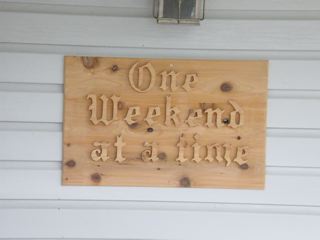
Several years ago my DH decided we could never afford to retire, so he wished to begin enjoying his retirement now, "one weekend at a time".  We searched for almost two years to find just the right place to escape the stresses of work and urban life, preferably on or very near the water.  We finally found just the right place and have been enjoying One Weekend At A Time whenever the opportunity presents itself.
My Dear Husband created this sign to announce his retirement policy.
Although I enjoy all the outdoor activities our weekend home has to offer, I can't escape from the stresses of work without some quilting, too!  To that end, I duly installed one of my favorite sewing machines at the camp:
This beauty is a Singer Model 15 treadle.  Collectors call the decals on this machine "Sphinx" or "Memphis".  I can't say exactly how old this machine is, but I don't think she was heavily used, as her decals are in beautiful condition.  Yes, I know it is possible to assign a date to Singer machines based on their serial number.  However, those numbers are only a guide to the general timeframe a machine was manufactured, and should only be used as a guide.  Besides, the machine is at the camp and I'm at home - I don't have the serial number written down anywhere.

The Singer Model 15 is a terrific workhorse sewing machine.  It sews a fantastic straight stitch and has a huge bobbin capacity.  These old machines were made to last and since they don't have plastic parts and electronics, they are simple to maintain.  My particular model only has a knob for stitch length adjustment, but later models have a stitch length adjustment lever and can also sew in reverse.  
The most distinctive characteristic of the Model 15 is the placement of the tension adjustment knob on the back of the machine.  If you find a machine with this type of tension adjustment, chances are it is a Model 15 or a Japanese copy of a Model 15.  Between Singer's manufacture and all the Japanese clones that appeared after WWII, the Model 15 was in production for a long time.  If you are looking for a reliable straight-stitch machine without investing an arm and a leg, you won't go wrong with a Model 15 or a clone.
Using a treadle sewing machine is pretty simple.  It might take a little practice to get the hang of it, but the treadle motion quickly becomes second nature.  The added exercise is a nice plus, too.  Living on the Gulf Coast - where power failures can happen with even a mild thunderstorm - it's also very convenient to have an electricity-free sewing machine! 

The Age of the Interwebs has made it easy to find antique and vintage sewing machine resources.  If you are interested in using a people-powered sewing machine, I recommend the Treadle On website as a great starting point.  It's a down-to-earth website loaded with practical information presented in a straightforward, but fond and often humorous way.  Treadle On!


Sunday, January 8, 2012

Pieces of the Past: New Home Sewing Machine Co. II

Continuing to delve into my scrapbook of sewing machine Victorian trade cards, here are some more advertising images for New Home sewing machines.  (New Home Sewing Machine Co. I)

Another common Victorian trade card theme was to depict the item being advertised being used as a completely different object.  In this card, the sewing machine is incorporated into a high-wheeled bicycle.
The Light-Running 
New Home Sewing Machine
Johnson, Clark & Co.
Orange, Mass.


An interesting historical note - bicycles were all the rage during the last quarter of the 19th century, and the first bicycle factory was started by a fellow who gave up sewing machine production to manufacture bicycles.

New Home sewing machine being used for ice skating!
Chariot a la New Home sewing machine.

Yet another strategy employed by Victorian trade cards involved a blissful or idyllic lifestyle associated with the product being advertised.
Doesn't every young girl dream of a New Home sewing machine?
La Maquina de Coser New Home De Movimiento
Suave Y Ligera.
A common English language card, I happened to also find this one in Spanish.  Roughly translated it says the New Home sewing machine is smooth and light-running.


These two cards have copyright dates from the early 1880s.  Don't you love the idealized version of life suggested when one owns a New Home sewing machine?
  
One could probably write volumes analyzing the images on these cards.  I enjoy the history, the art work and the glimpses of everyday life from over a century ago!


Tuesday, December 6, 2011

Pieces of the Past: New Home Sewing Machine Co.


I confess I have been in a bit of a funk lately and haven't felt much urge to sew.  I've finished about three-fourths of the quilting on the Deep, Deep Sea baby quilt, but otherwise have no quilting output to share.  I hope to finish the baby quilt by the end of the week - indeed, the precious baby arrived about 2 weeks ahead of his due date, so now there's a little more pressure to finish!  Once the baby quilt is done, there are several projects in various stages that should bring some satisfying sewing time.  I look forward to that!

In the meantime, I'll share some more antique sewing machine trade cards.  In response to a previous Pieces of the Past post, Kimber sent me a link to her beautiful antique New Home sewing machine.  Since Kimber shares my affection for history and antique sewing machines, I thought I'd share a few of my New Home Victorian trade cards today.

The first incarnation of the New Home Sewing Machine Company was actually named Johnson, Clark & Company/Gold Medal Sewing Machine Company.  That company was founded in 1860 in Orange, Massachusetts.  In 1882, the company reorganized and chose the name New Home Sewing Machine Company.  New Home merged with the Free Sewing Machine Company in 1927, but continued to make "New Home" machines into the 1930s.

One of New Home's favorite advertising themes was using "Before" and "After" illustrations of the virtues of their sewing machines.  An early image for Johnson, Clark & Co. shows Mother using a "noisy, hard-running old machine" which agitates the children and the dog.  The next image shows the peaceful household restored after Mother purchases a New Home sewing machine.

I shall exchange this Noisy, Hard-Running, Old Machine for a "New
Home", which my sisters, cousins and aunts recommend.
How quietly it runs!  It is really a pleasure to sew since I bought the
Light-Running "New Home".

Another before and after card pictures a fox who lost his tail in a trap.  He uses a New Home sewing machine to sew his tail back in place so it will never come loose again!
There was once a Fox who lost his tail in a trap. Meeting
his companions they mocked at him, so he bought
a Light-Running "NEW HOME" Machine, which
sewed it on so tight it never came off again.
A variation on the Before & After card is known as a "Hold to Light" card.  The image is designed so that when the viewer holds the card up against a bright light, the image changes.  Upon holding this card to the light, the woman sewing by hand is transformed into the beautifully dressed woman sewing with a New Home sewing machine.
"With fingers weary and worn"
"With eyelids heavy and red"
"A Woman Sat in Unwomanly Rags"
"Plying Her Needle and Thread"
By Holding This Card to the Light, You Will See A Happy Change in the Above Picture,
& What Caused It.
The verse on the card is actually from "The Song of the Shirt", a composition by Thomas Hood which described the tedious and tiring life of seamstresses before the invention of the sewing machine.  Sewing machines were advertised as time savers that would benefit women's health and well being, as well as allow them to devote more time to their husbands and children. Of course, the converse of this was that many men feared women would have too much time on their hands if freed from the labor of hand sewing! 

One of my all-time favorite New Home advertisements is a four page pamphlet.  The pamphlet cleverly illustrates an amusing Before & After scene demonstrating an unusual quality provided by a New Home sewing machine.
Act 1st - The Perplexing Question.
A New Home Machine or a French Sewing Girl.

Act 2nd - The French Sewing Girl Decided Upon.
The Arrival.
Act 3rd - The French Sewing Girl Duly Installed.
Act 4th - The French Assistant Did Not Give Entire Satisfaction.
A New Home Machine Has Been Purchased.
All's Well That Ends Well.


Monday, November 14, 2011

Pieces of the Past: St. Anne's Virtual Sewing Machine Gallery


Several years into my quilting life, I came across a treadle sewing machine in an antique store.  I was captivated by the colorful flower-like decals on the cast-iron machine head.  I rationalized that a quilter should have a connection to the quilters of history, and an antique sewing machine was a great connection.  The machine came home with me.  It proved a decorative conversation piece and my young sons loved to mash the pedal up and down.


Fast forward several years - another antique store - another sewing machine.  This one was in a charming wooden box and had a hand crank instead of a treadle.  It followed me home as well.  By that time, the internet was just beginning to demonstrate its usefulness as a research tool, and I immediately took to the web to find out more about my new machine.  I discovered a network of antique sewing machine resources and I was hooked!


It didn't take long to discover that as much as I loved the hunt for antique sewing machines, my house didn't have room for a huge collection.  Instead, I focused my collecting energy on sewing machine-related Victorian trade cards.  Victorian trade cards (sometimes called Chromos) became popular in the late 1870s when new technology came along that made color printing easily and inexpensively accessible.  The cards were used for advertising products and services; they became wildly popular due to the novelty of color printing and romantic images pictured.


It was easy to find sewing machine cards for sale online and I developed a nice collection.  As I acquired new cards, I was inspired to learn about the history of the sewing machines and the various sewing machine manufacturers in the US and abroad.  For several years I maintained a website - St. Anne's Virtual Sewing Machine Gallery - devoted to sewing machine trade cards.  Eventually I pulled the plug on the site, as web design and coding became ever more complex and sophisticated - I just didn't have the time to keep up with the changes!


I still am on the lookout for new cards, and thumb through the collection albums on a regular basis.  I hope you don't mind if I bring out some of these old chestnuts from time to time!  They are a great window into the past - giving a peek at the everyday life of seamstresses who stitched before us.

More Sewing Machine Cards